Monday, December 6, 2010

SoBo


That's South Bombay for non Bombayiites…. I find South Bombay to be Bombay rather than Mumbai... That is the beauty of South Bombay. A truly cosmopolitan place that is still untouched by the obsession with Marathi engulfing the rest of Bombay (ooops….. Mumbai). It is everything that Bombay stood for once; the financial capital of India and melting pot of cultures with a truly secular ethos where the only thing that mattered was your business acumen. Regionalism has no place here. This was the original Bombay that the British inhabited and developed. They constructed their administrative infrastructure in Victorian Gothic style. It is well planned, well constructed, and built to endure. The town (as this part of the city is called) is easily the most aesthetic part of the city and can easily compete in the infrastructure and layout with any European city. Each building is a landmark in itself. Vast open spaces, greenery, well laid out wide roads, the road along the beach, everything gels together. This is quite a contrast to the chaotic, disorganized concrete jungle that the rest of Bombay is.


The southern most tip of Bombay is Navy Nagar, the defence area, and is out of bounds for civilians. South Bombay ends at around the Mumbai Central station. North of Mumbai Central station was the area where general Indian population lived. It originally extended northwards upto Mahim. Dadar was the epicenter of Indian activities. This part of Bombay was for wretched, less fortunate souls. It was poorly planned and not much infrastructure was set up. Bombay's growth proceeded linearly, along a single road that extended north- south. Beyond Mahim was the Mahim creek, which was bridged by the Mahim causeway later and Bandra and the other suburbs came into existence. Then the suburban railway was constructed in the 1950s…. and slowly Bombay became what it is now.. good or bad… take your pick.


Western Railway Headquarters

Coming back to SoBo…..
Rajabai Tower & Mumbai University


When I came to Bombay 10 months back, the Marine Drive got me addicted to SoBo. That was my port of entry so to speak of. A long stretch of road fit for driving those fancy cars at speeds unheard off in Bombay. Nice place to hang out in the evenings.. or rather, any time of the day, with the cool sea breeze blowing almost all day. Evenings and early mornings see a rush of joggers here. Mumbai CST station is, needless to say, a heritage building, always crowded and it seems that all roads lead to this station. Rajabai tower, Bombay university, and BSNL building are all in close proximity to each other, along a tree lined avenue. When seen from a distance, these can be identified only in bits and pieces due to the thick foliage. These are located bang opposite the Azad maidan, that famous breeding ground of the country's leading cricketers. This vast expanse of land provides a welcome change from the concrete jungle and much needed breathing space.


Proceeding further away from the Churchgate station is the Flora fountain or the Hutatma Chowk. This is the fort area. To the right is the Kala Ghoda, the site for various cultural events, especially the Kala Ghoda festival. This entire road is lined by buildings in the the Victorian Gothic style. Straight ahead lies Colaba causeway, a delight for street shoppers and further ahead is the Gateway of India and the Taj and Oberoi hotels. This area is also pockmarked by iconic restaurants like Tendulakar's and Bade Miyan and also various pastry and sandwich shops.

Azad Maidan

No description of South Bombay is complete without referring to Nariman Point, the business district of Mumbai, or rather, one should say all of India. Lined by numerous highrises, all roads and railway lines lead to Nariman Point in the morning and away from it in the evenings. A hub of hectic business activity on weekdays, the region is overflowing with people.

Churchgate Station- Cut the crowds and its Europe


The best time to visit Town is on a Sunday morning…. Early morning. When all is calm. SoBo is transported back to the British era, when life was more relaxed, population sparse. One can take in the sights and sounds and feel the breeze and the early rays of the sun- things no one has any time for during a regular weekday… rather… the wind too forgets to blow and the sun glares down rather than soothe you. The roads are empty, shops are mostly shut, its like all of Town belongs to you. A lone, lazy sweeper sweeps the roads as if he has all the time in the world reinforces the laid back Sunday morning ambience here. One can have a relaxed breakfast of one's choice at the numerous eating joints that open early. My favourite is an English breakfast… suits the ambience, I feel. I usually travel on foot. That's the best way to explore if you don't want to cover the entire area in one day and just look forward to a leisurely Sunday.

Monday, November 8, 2010

First Indian South Pole Expedition

The following is a news article reporting the launch of the first Indian South Pole Expedition. Though India has had a presence in Antarctica for about 30 years, this is the first official south pole expedition. Indians have been to the south pole many times, but those were private expeditions or those launched by other countries. The team would be going in arctic trucks which are tailor made for travel on ice. Currently, only the Americans have a permanent station, Amundsen-Scott, at the south pole. This trip coincides with the centenary celebrations of the first man to set foot on the south pole (Roald Amundsen- Dec 1911)


Nov. 2 – India kicked off its first scientific expedition to the South Pole Monday evening, sending eight scientists on a month and a half long voyage aimed at uncovering how climate change has affected the environmental conditions in Antarctica over the last 1,000 years.

Led by Rasik Ravinda, head of the National Center for Antarctic and Ocean Research, the team will first travel to Cape Town, South Africa where they will then board a plane bound for Maitri – an Indian research base located on the rocky, ice-free Schirmacher Oasis in East Antarctica.

Traveling on specially-designed ice trucks, the research team is scheduled to leave Maitri Station on November 8, beginning an estimated 40-day, 2,400 kilometer journey to the South Pole and back during which the scientists will conduct a variety of tests and experiments.

"We will conduct meteorological experiments, [and] record humidity, temperatures, wind speed and atmospheric pressures during the 20-day trip to the South Pole, and other experiments will be conducted on our way back," the 62-year-old team leader said. The team is also expected to study snow chemistry and the continent's bedrock topography, glacial landforms, and atmosphere.

"No one has taken the route we will be taking to the South Pole," Ravinda said. He added that the team will only spend one or two days at the South Pole.


"We chose the expedition because no one has gone on this track and things have changed over time so new data on variations will be available to us," he said. "Everything is now linked to global warming."

Sources say that India's ambitious South Pole expedition emphasizes the country's eagerness to make informative scientific contributions to the global fight against climate change. The Indian team plans on bringing rocks, ice cores, and air samples back to India for research.

Sunday, September 12, 2010

Guest Blog: Antarctica, The Terra Australis Incognita

Dr. D. K. Biswas is currently the medical officer at Maitri. He is a doctor in the CGHS, from Kolkata. He can be contacted on ddkbcal@gmail.com.

The passion for Antarctica grew in me from my early childhood. I learnt in geography that there is a land on earth where nights prevail continuously for six months and continuous sunshine for six months. How was it possible? How could people survive there, if there be any? All these questions bogged the mind of a boy.

Later, one of our senior colleagues Dr. P. K. Malhotra opted for and left for Antarctica in the year 2003. This rekindled my desire to be in Antarctica at any cost. I started collecting information regarding both Antarctica and Arctic from news papers and net.

In one busy OPD hours one circular was placed on my table by my LDC, asking for deputation to Antarctica as Expedition Doctor. I made my mind to apply for this. I talked to my family one at a time regarding my desire for Antarctica. All were excited at first but after seeing the duration to be long 14 months and remoteness of the place and myself being a patient of diabetes thought it will be better if I abandon the plan. Moreover there was problem of my release from the Ministry and above all myself being fit in the Medical (Physical and Psychological) test at AIIMS, New Delhi.

However with lot of discussions with my family members and repeated inquiry from Dr. P. K. Malhotra, regarding the working condition, state of living and food available at Maitri, the Indian Antarctic station , I had submitted my willingness for being deputed as a Station Doctor for the 29th Indian Scientific Expedition To Antarctica.

At last by the grace of God, I got selected and released from my parent organization on 11.11.09. (Though after a little problem regarding release from the Ministry). My long cherished desire was going to be fulfilled now! In the early morning of 12.11.2009. I started from Kolkata. and reached Goa.. After completing formalities at National Centre For Antarctica and Ocean Research, Goa, we left for Antarctica on 15.11.2009. The schedule at NCAOR was hectic. We had to collect polar clothing and give trials, fill up feedback forms .We were briefed regarding our attitude and behavior on the way to and at Antarctica. The briefing was enlightening and we had a glimpse about what to expect at the unknown white Continent. The NCAOR people at GOA were very friendly and helpful. It was like they were seeing off their family members for a long journey.

On 19.11.2009 at about 11 AM local time the giant Russian aircraft IL-76TD (Illyushin) touched the long awaited airstrip (Novlazarevskaya) on continental ice at Antartica.. The journey from Cape Town to Antarctica was tiring due to continuous noise of the flight engine. Excitement of seeing a new continent was mounting as the destination approached. I dressed myself in polar clothing with great difficulty in a limited space of the aircraft. The very first thought which came to my mind was how to step on the ice, how to walk, will it slip or will the glare of the sun and reflections from ice make me blind? However with great caution I placed my feet on polar ice cap. These are hard ice formed by continuous deposition of snow over hundreds of thousands of years. As snow crystals fall and pile on top of each other creating huge weight that compress the earlier snow and converts it into ice sheet. It is blue in color shiny glassy and very hard. Its maximum thickness is more than 4 Km. It is in continuous motion from high interior to the coast. I walked with great caution like a toddler. It was wonderful to see vast sea/sheet of ice everywhere meeting the horizon with the bright sun in the real clear deep blue sky. In spite of the scorching sun above the biting cold seems to seep deep into the bones. There was nothing to be seen in the vast desert of bluish white ice except the Giant aircraft, few feeder planes with ski on wheels, Pisten Bully, Skidoo, some tents, housing modules and some Ground Staff. Pisten Bully is the snow vehicle equipped with heater, GPS and VHF radio sets, from Germany. Skidoos are the snow scooters from Norway. Members of previous team and leader of our team came to receive us in Pisten Bully. They asked us to remove the snow goggles to identify us but with fear of snow blindness we were hesitant to do so. However later we removed it and found no difficulty if eyes are left uncovered for short period only.

At Maitri, the sweet home outside home, there was warm reception for us by the inmates and also by the Antarctic Skuas .They are birds having features of both eagle and duck. They are the regular summer visitors to Maitri. We had light snacks and tea followed by lunch. Later we took rest in summer camp container. This too was unique. It is a self sufficient accommodation for four which is comfortable even in such harsh condition. Though there was attached bath, there was no water supply and we had to use the common bath complex outside. In the evening we were briefed regarding use of dry toilets and other utilities of the main station, rules and regulations. We were introduced to all (Old and new) members. After dinner we went to our summer hut module (Myself alone in my module) about 100 meters from main block. We were tired after such a long and eventful day and the wrist watch showed 11 PM. It was time for bed but outside there was bright sunlight! I drew the curtain and slept.

However in the morning experience in the toilet was not very pleasant. In such freezing cold using the toilet after climbing on the high platform needs expertise. However I went through it without any mishap. Though when I think of it, it was the first horrifying experience in the continent for a man of a tropical country who had had no experience of snow except for some short tours within the country.

The facts which astonished me most were the absence of mosquitoes, cockroaches, ants and spiders. No spider webs hanging hither and thither. Food items like cakes biscuits, bhujia, snacks, lying open on the table are all crisp not attacked by insects. May be Mother Nature preserves them as it is for us, considering the harshness of the condition! Gradually on exploration we could see penguins (Adelie) incubating eggs in their rookery near the coast. Wavy ridges of shelf ice near the coast appeared to me as frozen waves of sea. On the backside (Southern) of our station the receding continental ice sheet touching the clear blue sky (which is supposed to be a million years old) fascinated me. Water from this ice cap accumulates in Priyadarshini Lake and provides water supply to Maitri round the year. During winter water can be found under cover of about 2 meters thick ice.

The solitude is broken by the continuous howling of the winds and grunting of the generators. They are our life line in Antarctica. It seems very funny why till date we are having those giant noise makers especially in the pristine condition like this, whereas in main land we are using eco friendly noise proof gensets.

Here time taken to do any outdoor job can not be compared to that of the mainland. Even driving in a nail is a major job and when done correctly, is an accomplishment. Most of the outdoor jobs are done during the summer months when the weather is good. Actually effective working days are very few due to bad weather like high winds, blizzards and cold which are frequent. We have to watch out for "workable weather" and cannot afford to let go of a single such day.

Members of the expedition team need to go to the ice shelf, about 120 Km. away, to bring the yearly quotas of fuel, food items building materials and other logistic items in convoy. These are kept in sealed containers, brought in ice class ships. During convoy a series of ice class vehicles towing empty containers for fuel, back loaded containers with unused waste materials, container for living module (Banjara) and container for generator set (Jeevan Jyoti), move towards the shelf. The weather condition is quite different from that of inland. Almost always it is harsh and they have to work hard to get the job done there. Sometimes they get stuck up there for days together in blizzards. High winds and blowing snow may lead to almost zero visibility, which is a condition called" White Out" where a person loses his perception to surrounding. On the way, though delineated by the GPS, sometimes they encounter crevasses. These are very dangerous and often life and materials are lost. While returning from convoy a sense coming back to sweet homes arises in the mind at the sight of the Maitri.

It is aptly said that Maitri is representative of mini India. Here people come from all corners of the country and there is ample opportunity to get exposure to various cultures and languages and religions. A unique intimacy grows between the Maitrians which cannot be described in words because such ties will not be possible in the mainland. It teaches us a lot regarding doing all sorts of job leaving behind the rank and status one holds in mainland.

It is a wonderful place where one can come to know one's own self being in the solitude far away from the hassles of daily urban life. Borchgrevink the great Australian Explorer aptly said "The silence roared in our ears, it was centuries of heaped up solitude." Let the civilized mankind not break it!

Saturday, August 7, 2010

A Weekend in the Sahaydris


It was a long time since I indulged in some hard core adventure. I was itching for some excitement. But time still did not permit me. So I settled for a feel of adventure and nature. Adventurous though it was, but very short lived. It was over before I knew. It was a very memorable and fun day nonetheless.
I booked myself with an adventure group for a Sunday trek to Tandulwadi on the 1st August. I was told that there would be a total of 13 members in the group. So at 6 am I met the representative of the company at Bandra station…. An amicable, talkative, workaholic girl, Bianca. She worked effortlessly at getting all the group members together. We were all from diverse backgrounds…. Doctor, banker, tax professional, corporate professionals, creative people and so on, all typical Bombaiites (not mumbaiites.. mind you). It was a lively, young group. We left it 2 SUVs for… god knows where. I could not make out the direction we were going in. it was only when we reached Borivli that I regained my orientation. We passed places that I had only heard of but never seen- Virar, Bhayander, Vasai, Dahisar and a few more that I cannot recollect. The trip was noisy, with the 2 girls, Priyanka and Vanessa constantly chattering away and keeping us from going to sleep. Bianca kept up the tempo with her interest in knowing people. The others were bored stiff. The highway was in a mess, something I have become used to while in Mumbai. Though it was early morning on a sunday, but the traffic was anything but sparse. At last we were out of Bombay. The concrete was behind us. And all around was fresh, green vegetation- forests or fields. A welcome sight after living in that urban hell called Bombay. It was raining sporadically, sometimes a downpour, sometimes a shower. After about 3 hours, we turned towards what was apparently a village road. We came across a signboard displaying the name 'Tandulwadi' that meant rice bowl. And there were rice fields all around, with people working in them, knee deep in water.


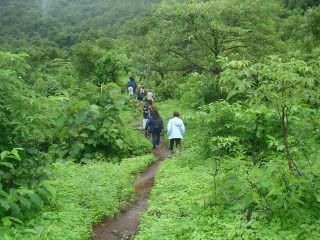
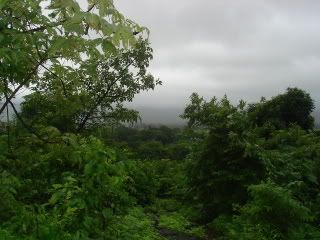
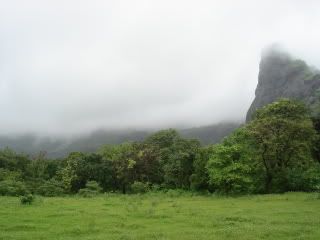
We soon halted outside a village. This was the beginn ing of our trek. I had presumed that I would be a cakewalk and prepared for a leisurely walk. I was soon to be proven wrong. This was going to be some adrenaline pumping stuff. The initial part was actually easy. There was a light shower now and then. But nothing that required rain gear. In fact, I took off my raincoat soon enough, as did the others. As expected, the trek passed through a lush green forest. The climb was a lazy one. There was a lot of friendly banter going on. Some were quiet, others boisterous. That kept up the mood and the tempo. Gerard, the eldest among the lot was feeling the strain. He walked leisurely. But when he could not keep up with the group, he volunteered to stay back in order to not slow down the group. Soon enough, we reached a clearing in the forest. That was a beautiful sight. A green carpet all around, ringed by trees, and just ahead of us towered a steep, rocky mountain whose peak was shrouded under a blanket of clouds. The other hills nearby were similarly draped in a veil of clouds. This was picture perfect.

One could take wallpaper quality photographs here. It was raining fairly hard now. To add to it, it was very windy as well. Uncomfortably so. The scene was further 'enhanced' by the presence of two dogs and a bull. They had left their markings around. Priyanka was gracious enough to provide us entertainment by voluntarily stepping into them. Mark also made his presence felt by participating actively in all the tomfoolery, along with Oswin. We felt that the trek was about to be over. When someone sprang up with the thought that we were going to climb that mountain ahead of us, he was derided. But soon enough Bianca and Govind, our guide informed the group that we were actually going to climb it. Well… that would be something really. And we soldiered on.


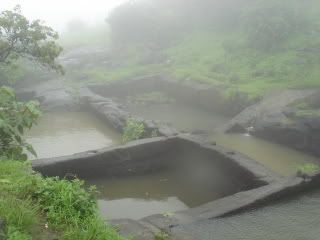
Bit by bit we clambered. The climb was steep. We were more often than not on all fours. The rocks were slippery and really dangerous. I was covered wi th slush. The rain was sometimes torrential. But that was not a concern now. The raincoats were forgotten. We had to get out of this mess first. We made our way through the dense vegetation and met some interesting wildlife on the w ay, including crabs. My brief brush with rock climbing came in handy here. Each step had to be taken cautiously. There was no room for error. One wrong step and a lethal drop awaited us. No photography was possible here. I valued my camera more than some fantastic shots. We soon reached a small clearing which led us to an artificial pond filled with muddy water. The rain and t he wind made life miserable for us. There was n o tree cover. This was the end point of the trek we were to have lunch there. But the wind made it impossible. Govind suggested that we go to a clearing nearby which had tree cover and hence would provide some protection from the wind. He was right. There was another clearing some distance away which had a tree cover in the windward direction. We chose some rocks near the trees where the wind was less and set up camp ther e. Lunch was readymade. It consisted of thepla, sandwiches, fresh salad, farsaan, some fried stuff, and finally apples. It was satisfying and gratifying. We had our fills and lazed around a bit.


We were all wet and miserable. But the daunting task of going back the same way haunted my mind. That was gonna be something. Finally we moved on. Initially, things were ok. I chose to do the downward trek on all f ours. That was the safest and fastest way to do it. And soon enough I discovered that I was right. I clambered do wn relatively effortlessly at my pace, though I was looking like a slush covered wretch by the time the trek was over. The way back did not take as long as the way up, and expectedly so. We were totally sapped by the time we were half way back. There was total silence from the brat pack. We lumbered back like a sack of potatoes. We reached back and immediately changed into dry clothes as soon as possible. That was heavenly. We dosed off soon, except for the driver, that is..

The way back was dull and boring. Soon, we were snaking our way back through traffic……. Ugggghhhh. I better not spoil the mood.

Thursday, August 5, 2010

Destination Norway- III


The third day was spent at the conference. The venue was Norwegian Trade Fairs at Lillestrom, the closest station to the airport on the local train. The conference venue was truly massive and very very spacious. The inauguration ceremony was also attended by Mr Prithviraj Chauhan, Minister of Science. He spoke big words about India's role in the scheme of things at the pole. He was in Norway for his trip to the Indian Arctic Station, Himadri. The purpose of his visit to the Arctic and to the conference is still unclear to me. The conference was finally declared open by Prince Albert II of Monaco, the latest entrant to the Antarctic Treaty.
Multiple programs were on simultaneously. Polar cinema, reindeer herders' conference, multiple oral presentations, poster presentations, polar exhibitions……. All on at the same time. A diverse range of scientific disciplines were on display. Most of the program was latin and greek to me. Polar cinema was the most engrossing, with movies (mostly documentaries and short clips) from all over the arctic. There was very limited material presented from the Antarctic. The conference got over at about 4 pm. Then I went to Oslo central station, spent some time exploring the place, tasting local delicacies and then I went to meet Paresh, an online friend who happened to be in Oslo. It was nice to spend time with him and his wife and have good Indian food in Oslo. He was very hospitable and guided me about what to see in Oslo. It was now time to go back for some good conversation at the youth hostel, and a good sleep.


The next day was again conference time. But I had plans to explore the forests around Oslo as well. So I left the conference early and went to Sognsvann by metro. By the time I reached Sognsvann, it was raining pretty heavily. Luckily, I was carrying an umbrella. That's mandatory in Oslo, as it is in Bombay. Inspite of the rain, I went for a short hike into the forests. It was all coniferous vegetation. The surroundings reminded me of my treks to the Himalayas. Everything was quite similar, except for the terrain. Unfortunately, I did not take pics here because of the rain. Then I went back to Sognsvann and explored the area. It was a nice, quiet area with neat houses and pretty gardens. Not many people could be seen. This being the spring season, lot of flowers could be seen all around. It was a nice, easy and relaxing walk.


This evening, the conference organizers had organized a party at the Fram museum. The Fram museum was located at Bygdoy that was accessible most easily by ferry from the Aker Brygge. The attraction was the museum and not the party. The Fram is the ship that during its time sailed to the highest latitudes north and south. It was also the ship that carried the first man on the South Pole, Roald Amundsen to Antarctica. Therefore, it has a prominent place in the annals of polar exploration. The museum was built around the ship. The Fram was a wooden ship, like all ships made in that era, but had a reinforced, rounded hull, to be able to withstand sea ice. Numerous artifacts were from the expedition were on display there… clothes, food, rifles, skis, rations, so on and so forth…. I explored the ship from inside as well… rooms of all the occupants, including Amundsen. This museum took me back to Antarctica. I could relate to what his experiences would have been like, having experienced Antarctica myself.


The day finally ended at 10 pm, and I retired to my room. The next day was some big adventure… a cycle ride to Drobak, a small town 50 km away.

Sunday, July 18, 2010

Destination Norway- II

The next day, I started to explore Oslo. The first trip was to the office of the conference organizers office near Majorsteun. I got my conference entry pass and then I left for Holmenkollen ski jump. Holmenkollen is located inside the city limits. Imagine…. A ski resort within a city. It is an artificial ski resort, with a single slope located among the low hills around Oslo, set amongst a lot of greenery. The area was well forested, and was served by a local bus stop. It was just within limits of the city bus service, though Oslo is not a very big city. The road leading to the ski slope was steep, and lonely. I crossed a resort on the way, which was under renovation. That must be a cosy, noisy place during the winters…. The façade of the ski slope displayed a sign board conveying that Holmenkollen was to host the Scandinavian winter games.


The Oslo Metro (T- bane)


The ski slope itself turned out to be quite an anticlimax. Obviously, I never expected any snow, but the summer pics online were pretty attractive, with lots of greenery and flowers in place of snow. The reason was that the ski slope was under renovation for the games. The ground around was all dug up and full of construction material. There was nothing much to see there. However, the area around was interesting. The weather was sunny, and the air was cool and crisp. The surroundings were green. It was a nice place to walk. In fact, walking in Oslo was always a pleasure. So I loitered around the area for some time, snoozed on the green grass and then caught the bus back to Majorsteun.


Holmenkollen ski slope

I met a Pakistani on the way back, who told me that I must visit the Vigilande park near Majorsteun, which was supposed to be the only place worth visiting in all of Oslo. So I decided to go there. The place was quite interesting…. A huge garden, with walkways, kids playing, cycling, skating, lots of attractive sculptures and of course….. greenery. I walked around a bit, and found the place pretty much like Lodhi Gardens back home in Delhi. By this time, it was 6 pm. Time to head to the Oslo City Hall, where the pre conference ice breaker get together was to be held. So I took the Metro to the National Theatre, which was close to the venue. The National Theatre area itself was quite a heritage area. They were ancient buildings, constructed in typical Nordic style (though I don't know what that means ;). It was the cultural hub of Oslo. The Oslo City Hall was just a short walk away. The get together venue was in tents behind the City Hall. The tents, it turned out were the ones used by the Eskimos of Norway… the Saamis. And it further transpired that the entire evening was dedicated to the Saamis. They presented cultural events from the Arctic.. music, dance, dresses, display of Arctic life… that came across as nothing too easy. The food was totally new to me. I was certainly looking forward to it…. Complete with meats and wine.. a light meal. The meat, we were informed was reindeer meat. So there was reindeer meat, reindeer liver, and … hold your breath… reindeer tongue. The reindeer, we were told was an integral part of life in the Arctic….. just like the camel in a desert. Of course, all that is changing now, with Eskimos adopting a more western lifestyle and their villages and towns becoming more modern. I met people from so many nationalities, that I was amazed by the colourful world we lived in. This was my first such experience. People from all over the world under a small tent, from as off beat places as Papua New Guinea. The South Americans bore a striking resemblance to us Indians.


Oslo City Hall


The Arctic Tents


The Arctic People- Saami


Reindeer Meat

Sunday, July 4, 2010

Destination Norway- I


Finally, two and a half years of hard work and planning and a grueling, 15 month long Antarctica trip finally paid off. I was to present 2 papers at the biggest ever polar research conference, the International Polar Year Conference at Oslo, Norway. I reached Oslo on 6th June 2010. After getting foreign exchange and inquiring about the various modes of transport available to the main city, I settled for the Oslo suburban train (tog in Norsk). The best options were the Airport express train (Flytoget) and the Airport express bus (Flybuss). But both these would drill a hole in my pocket. So I reached the Oslo central railway station, and then took a connecting train to Grefsen, the area where I was to stay. The journey from airport to the city centre was a pleasant one. The train interiors were heated, and plush with cushioned seats. The conductors were well mannered, smartly dressed and very helpful. The train passed through the outskirts of the city, giving me a glimpse of the countryside. There were rolling expanses of lush green grass with neat houses and pretty gardens dotting the scene. There was not a shade of brown to be seen anywhere.Grefsen was a tiny station, with not a soul in sight to guide me to my hotel. Luckily, I found signboards all along the way. My hotel was a pleasant walk from the Grefsen station.

Suburban Train

The air was chilly, crisp and very clean. The ground was wet because of recent rains. The youth hostel was located just above a vast meadow lined all around by coniferous trees. It was a pleasant sight. I checked into my room, settled down and then went out to explore the area a bit. The hostel staff guided me. They were extremely hospitable, polite and helpful people. I purchased a 24 hour multimodal transport pass and went out. It was summer time and days at those latitudes were long. So I could be out till late at night. In fact, there was no period of complete darkness at all. It was dusk at midnight; then again the day began to break. My Antarctica camera was my constant companion. I decided to explore the riverside. It was 4:30 pm. The sun was shining bright. I was told that this was a rarity in Norway, and so its an ideal day to explore the riverside, that divided Oslo into two. All of Oslo would be there. So off I went. It was a pleasant walk through the narrow streets of Oslo, overrun by tram lines. I asked for directions at every step, till I reached a small stream. I walked along it, hoping to reach the river. When I didn't, I asked for directions again. The person informed me with a smirk that I was in fact walking along the river all this while. This, I thought, was THE river????? What an apology…. Back home in India, we called this a nullah. Anyways, I walked along it. The 'river' notwithstanding, the walk along a riverside was indeed very refreshing. There was a lot of greenery all along, people sunbathing, enjoying the barbecue and beer or wine. There were a lot of people running, cycling, roller skating, skateboarding, orsimply walking. This was what I later discovered was a daily routine in the life of Oslo residents. They were very sporty people. They liked to be physically active. So inspite of rains, people could be seen wearing raincoats and jogging or cycling. Kids could be seen playing soccer. Lots of people were driving with their personal boats lugging behind. During the winters, everyone was skiing. Coming back to the riverside….. I reached the Oslo central station. It was 6 pm.The Oslo central was the transport hub of the city. It was a huge complex where all modes of transport converged. All buses, trams and railway lines passed through that complex. It also housed numerous fast food joints, departmental stores, foreign exchange counters and post office. I explored it a bit. The public transport system in Oslo was impressive.

It consisted of the bus (buss in Norsk), tram (trikk), suburban train (tog), metro (t- bane) and the ferry to the museum area in Bygdoy. The tickets were common to all these modes with the rates too being similar. What was striking was that the interiors of all these modes were similar too. They were all quite comfortable, heated, clean and plush. The streets of Oslo were quite narrow. Finally, I took a tram back, picked up a pizza for dinner and retired for the night after chatting up with people of other nationalities at the Youth Hostel.


Saturday, April 17, 2010

Cyclists.in


Folks… the caravan now moves to Mumbai. From the remotest corner of the earth to the most crowded one. Though I have been here for 3 months, but the city did not allow me to post anything till this now.
It was another warm, humid Sunday morning. I pulled Abhishek, a medical student out of his bed at 6 am and well left for Marine Drive on our bicycles. Marine Drive is half hour bike ride away from Parel, where we are staying. The route was miserable as usual. I am used to the filth on Mumbai roads and the narrow congested roads. But the destination was pleasant. A cool sea breeze, clean sea face and a pristine blue sky untouched by the congestion of Mumbai, the early morning walkers…. And so on.

So we sped along the Marine Drive, from Girgaum Chowpatti to Nariman Point. There was minimal traffic, the sun was rising fast and it was getting warm. All of a sudden we saw a swarm of cyclists hurtling by. Most of them were in full cycling gear- helmets, gloves, knee guards.. and the works. We took them to be regular, hardcore cyclists, if not thorough professionals. Then we heard screams of “join us join us” coming towards us from the direction of the cyclists. Without batting an eyelid, we went after them. And stopped at the end of the road where the crowd had gathered. I noticed that they were just a Sunday holiday crowd. Professionals like us who are free only on Sundays. They included all age groups, including middle aged, pot bellied, ageing people and house wives. Some of them had bicycled it down all the way from Borivli (45km away) and would also go back on bicycles. These people were a part of a local cycling group, who meet off and on. Their mission this week was Marine Drive. So now it was time for a round trip around Marine Drive. That got over in no time. And we were soon headed for PJ Hindu Gymkhana, again at Marine Drive, for breakfast. It was all pre arranged. The cost was Rs 100 per head. We ate indulgently and met some new people. It was nice to meet people from other fields and get new inputs. It was really refreshing. I decided to join the group then and there.
It was then time to head back to our hostel as it was getting warmer and warmer and also more humid. The ride back was really unpleasant…. Traffic, pollution, heat… blah blah blah….

Monday, January 4, 2010

Frozen in time: Captain Scott's hut

Captain Scott whose Cape Evans camp will be preserved
(Courtesy: The Independant)

For those few hundred visitors who make the long journey by ship each year to see the hut for themselves, it looks eerily as if the adventurers had just stepped outside. Yet it is nearly a century since Robert Falcon Scott and his men embarked on their doomed march to the South Pole, an episode that was to go down as one of the most vainglorious in the heroic age of exploration.
Scott's Hut
Courtesy: Unknown
Stores of rations
Courtesy: Unknown

Today their huts at Cape Evans on Ross Island, complete with preserved jars of Heinz Indian Relish, tins of boiled cabbage and still-edible pats of butter, are undergoing a vital restoration. Here, where Scott's party endured a gruelling Antarctic winter as they planned their assault on the South Pole, conservationists hope to restore for future generations a permanent monument to the bravery of the men who gave up comfortable middle class lives to risk all in the blizzards and sub-zero temperatures.

Courtesy: Unknown


Nearly £3.5m has been raised to safeguard the quarters which became a microcosm of Edwardian society during the opening stages of the Terra Nova Expedition of 1910-13, Scott's second and final foray on to the frozen continent.
The most urgent work has already begun as experts announced this week that they had uncovered 300 new artefacts belonging to the expedition. But time and the elements are stacked against the future survival of Scott's hut and its 8,000 items of equipment and expedition memorabilia, and it has been declared one of the most endangered sites in the world by the World Monument Fund.

The Laboratory
Courtesy: Unknown

Philippa Foster Back, whose grandfather was part of Scott's 1910 team that helped build the camp, chairs the UK Antarctic Heritage Trust. "We are in a race against time to preserve this irreplaceable part of our heritage. The end of the fundraising is in sight but the final mile is going to be the hardest," she said.
The fundraising effort, which is being led in Britain and New Zealand but has drawn support from around the world, is seeking another £175,000. Half the money has been donated by the private February Foundation, with the balance coming from small donors and polar enthusiasts. It is hoped the work will be finished in time for the centenary celebrations in 2014 when millions will be able to pay a virtual visit to the hut via the internet. But much work must be done before then. Wind deflectors have been fitted to prevent recent heavy snow from building up around the prefabricated dwelling and crushing it. Last year 85 tonnes had to be shovelled away from the structure and water from melting ice continues to endanger the interior.

Unopened Crates

Courtesy:www.gfsc.nasa.gov/


Stoves, lights, clothes, bedding and harnesses for the team of dogs remain where they were left. Objects such as tins, corks, scientific test tubes and compressed "patent" coal bricks from Cardiff remain intact.
Sir David Attenborough, one of the campaign's leading supporters, described the base as "a time warp without parallel". "You walk into Scott's hut and you are transported to the year 1912 in a way that is quite impossible anywhere else in the world. Everything is there," he said. The actor and presenter Michael Palin has described it as "one of the great memorials to exploration anywhere on earth".

Courtesy: www.gfsc.nasa.gov/


The 15m by 8m hut was built by Scott and his team when they landed in Antarctica in 1911. It took a week to erect but was well-loved by the men who called it home despite the hardships they endured there. In his journal, Scott observed: "The hut is becoming the most comfortable dwelling-place imaginable. We have made ourselves a truly seductive home, within the walls of which peace, quiet and comfort remain supreme. Such a noble dwelling transcends the word "hut", and we pause to give it a more fitting title only from lack of the appropriate suggestion."
By the time of his return to the Arctic, Scott had become a hero of Edwardian society and the expedition enjoyed support from the government and people alike. Schools and churches raised money to buy blankets and tents, and news of their progress was eagerly awaited back home. Scott recreated the social structures within the quarters that he had known from the navy. A bulkhead of bottled supplies partitioned the living area. Space was set aside for the 16 officers and scientists. The men bedded down in the wardroom at the east end and dined in the messdeck at the west end. The wardroom was dominated by a large table and spindle-backed chairs. On Sundays the table was covered with a dark blue cloth, although for ordinary meals it was covered with a white oilcloth. There was also a player piano and an HMV gramophone. At the eastern end a darkroom was built and workbenches were constructed for the scientists to conduct their experiments. The men amused themselves by working hard and giving lectures on their specialised subjects – anything from watercolour painting to the history of Japan. On special feast days such as mid-winter's night, they dined on roast seal.

Courtesy: www.gfsc.nasa.gov/

Scott's goal was to beat his rival Roald Amundsen to the Pole. He had been greatly disconcerted on learning that the Norwegian changed his plans to conquer the North Pole after a successful American expedition and set sail for Antarctica instead to challenge him head on.

The Kitchen

Courtesy: www.tiger.gsfc.nasa.gov/


In the end Scott, 43, and his party of four were narrowly beaten to the prize and it was on the return journey that they perished amid scenes of unimaginable suffering. The last entry in the explorer's diary dated 29 March 1912 reads: "Had we lived, I should have had a tale to tell of hardihood, endurance and courage... which would have stirred the hearts of every Englishman. These rough notes and our dead bodies must tell the tale."